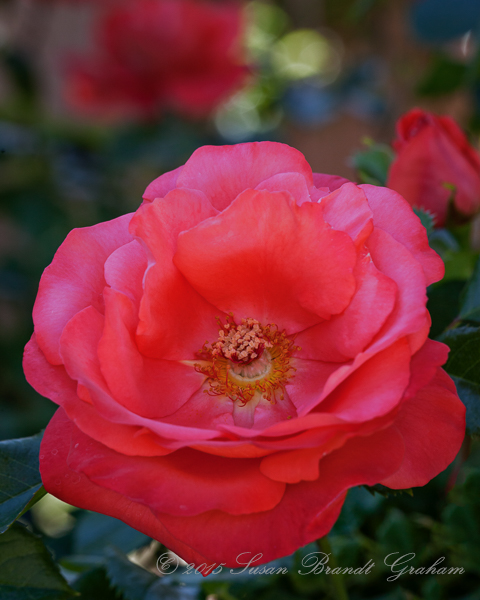
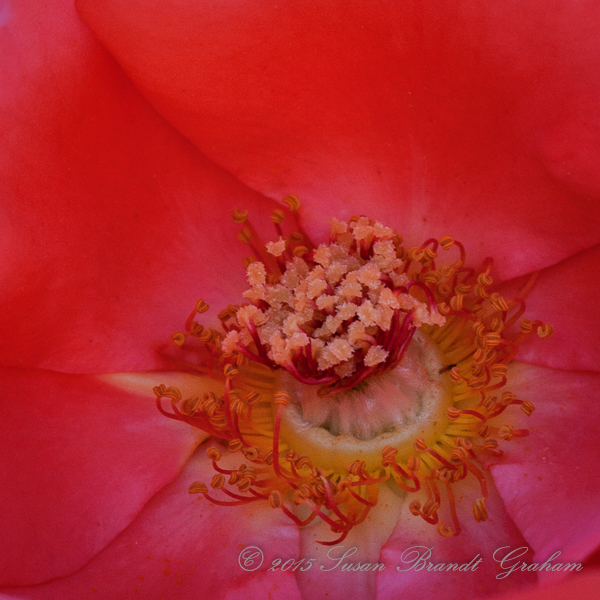
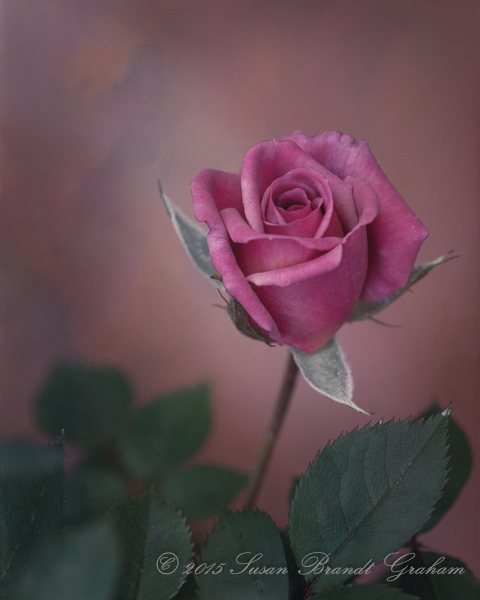
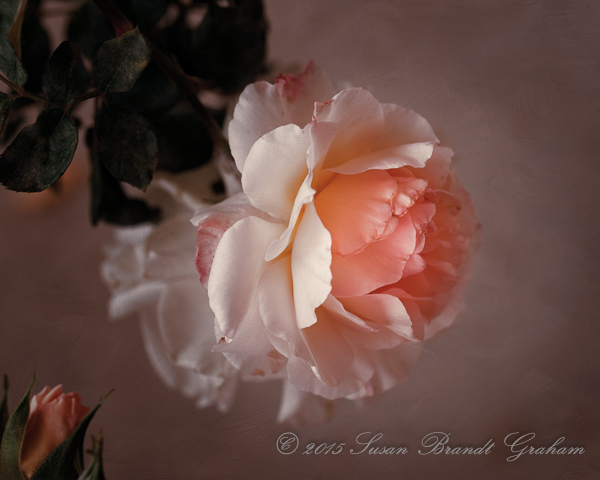
Gemini, A Great Hybrid Tea Rose for the High Desert
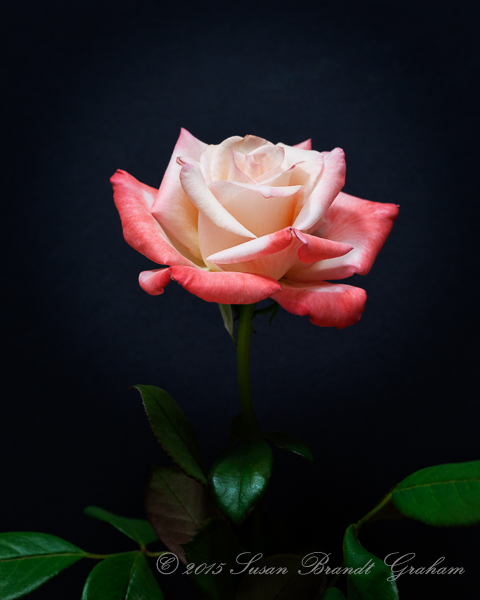
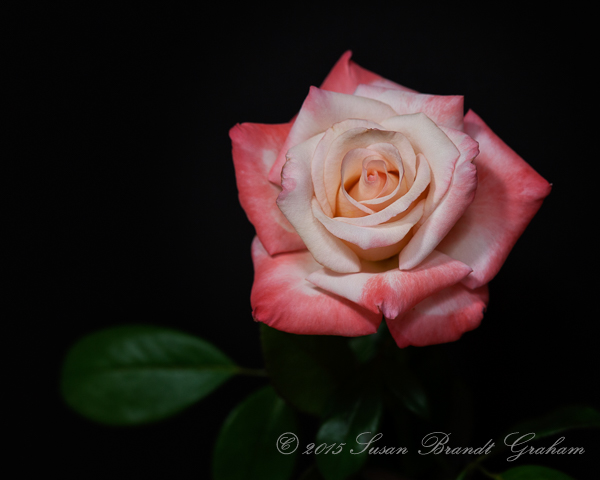
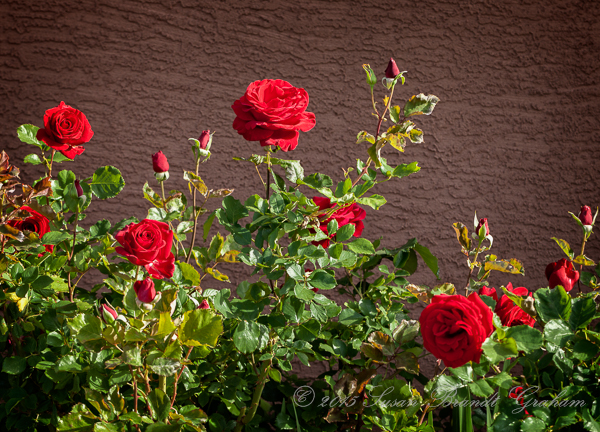
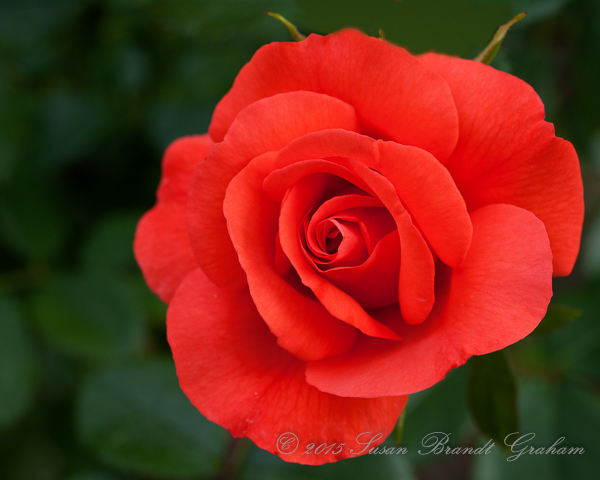
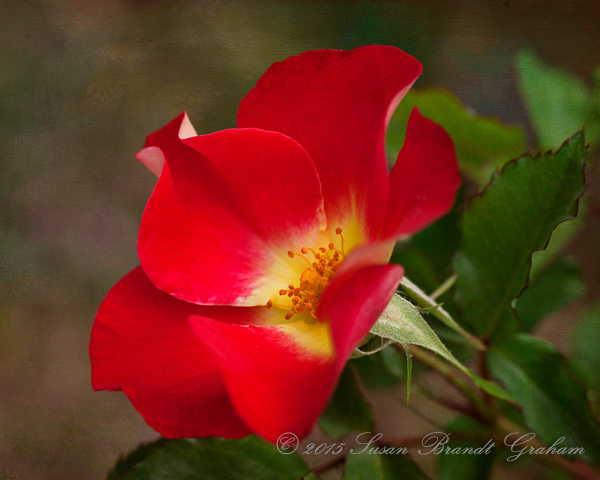
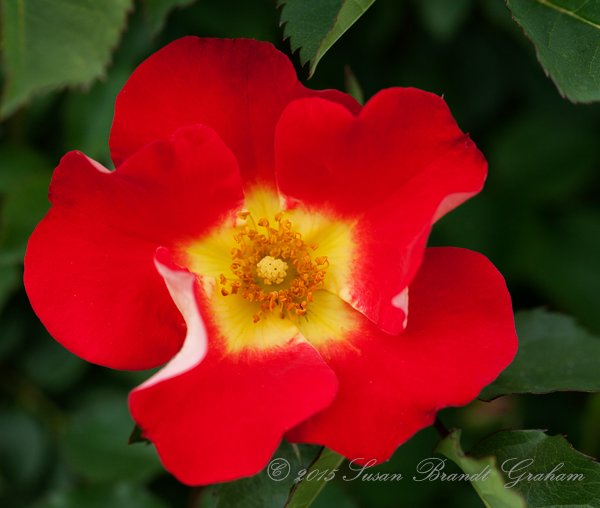
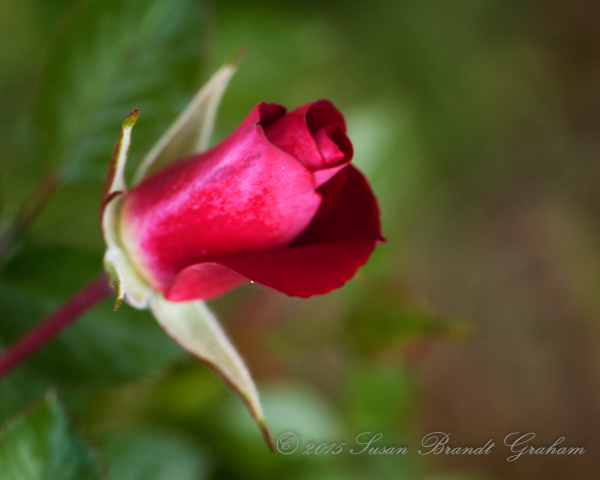
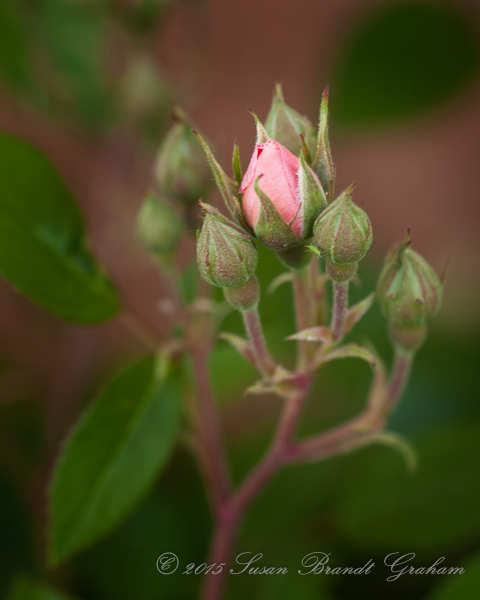
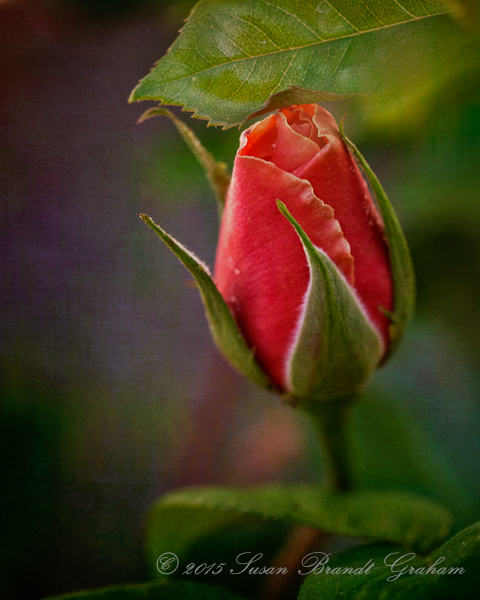
Gemini is probably my favorite hybrid tea rose to grow here in the high desert of the Southwest, Albuquerque. As beautiful as it is, it is equally tough. It tolerates the summer heat. Mine was not damaged by the extreme cold of February of 2011. The colors are wonderful. The form is close to perfect in almost every bloom.
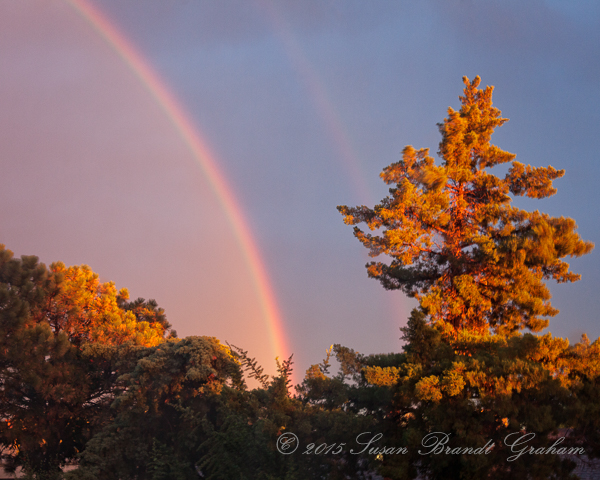
Last evening Albuquerque experienced one of our famous summer thunderstorms – lightning, thunder, brief heavy rain that produced rivers running in streets, full arroyos, and some brief flash flooding. I got 1″ of rain in less than an hour, enough that there was standing water for a short time (I hope I’ll have a lawn again for a few days!).
Albuquerque is well-known for double rainbows after thunderstorms. But, this was late, and the clouds were heavy and the rain continued, albeit at a slower rate.
And, then, unexpectedly because it was late and still raining, I caught a glimpse of golden light out of the corner of my eye. Such light after a storm here often produces rainbows looking east toward the Sandias. But, there were no rainbows from the usual view. But, with that light, something had to be happening! This view is looking south. I have never seen a rainbow in this position in the years I have lived here.
The light, and thus, the rainbows, lasted less than two minutes. The time was short, but the image in my mind will last.
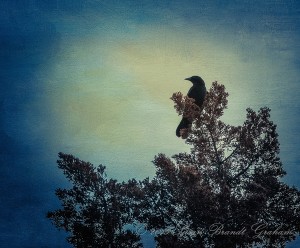
The tree that was lit is The Old Crow tree, so named after a brief visit by a crow in January.
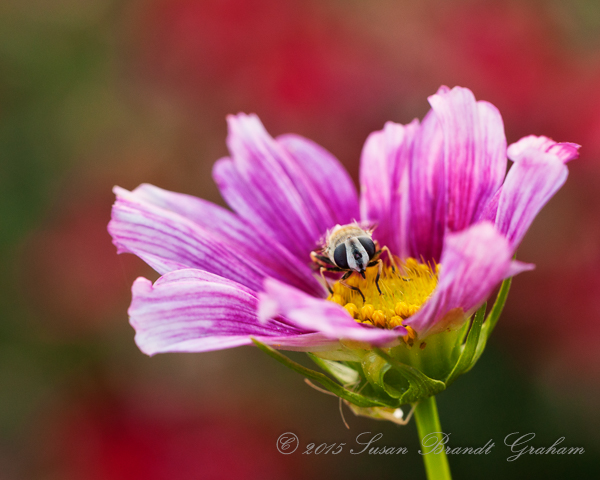
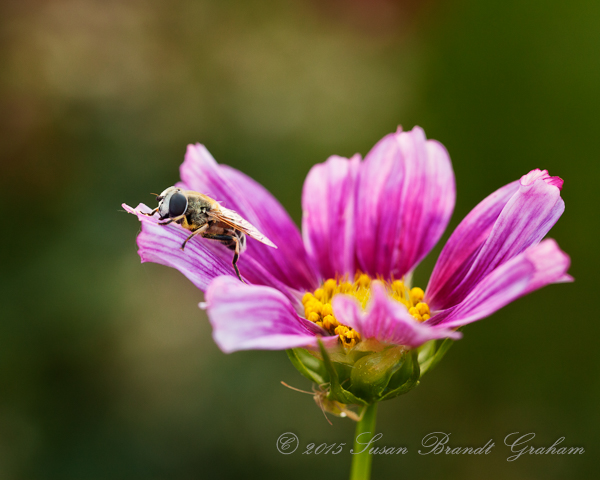
The summer annuals I grow regularly are sunflowers and cosmos. They attract a variety of pollinators and the birds like the seeds. This year I got them planted in late April, and they are now in bloom.
This morning I found this bee on a cosmos, and it was still cool enough that the bee posed for a couple of good images.
I am fortunate to have neighbors who also grow things to attract pollinators and birds.
Mermaid is a beautiful old garden rose (Hybrid bracteata 1918) that long time readers here know well. In May of 2006 it was reaching its peak after having been planted several years before. It took Best of Show at the Spring 2006 Albuquerque Rose Show, along with the ARS Victorian Award for Old Garden Roses with unknown date of introduction or introduced in or after 1867. Who could have imagined what December of 2006 would bring?
Mid December of 2006 brought an 8 inch snowfall to my house. It was heavy and wet, and pulled Mermaid and its trellis a little away from the wall. But I was sick at the time, thought there wouldn’t be more snow at least for a while, and I could repair things when I felt better. Big mistake!
A week later or so I got an unheard-of-for-here 22 inch snowfall at my house! The melting and refreezing, melting and refreezing added more weight, and in the middle of one night with a noise loud enough to awaken me at the other end of the house, Mermaid and trellis came crashing down across the patio. It took me weeks to get that mess cleaned up to the point I could walk out into the rest of the yard. To do it, I had to cut everything, including the clematis that had been growing with Mermaid, off at ground level. I thought everything was gone.
Imagine my joy at finding tiny basal breaks later in the spring of 2007! Mermaid did not grow a lot in 2007, but the companion clematis came back more rapidly. 2008 was even better. By 2009, things were looking very good. At the Spring 2010 Albuquerque Rose Show, Mermaid once again won the ARS Victorian Award along with Best of Show.
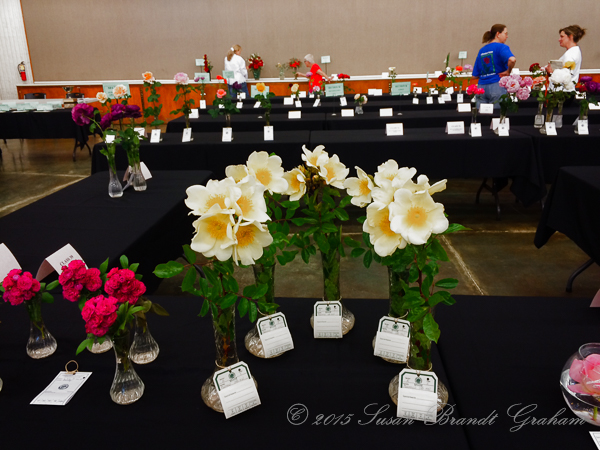
The 2014-2015 winter in Albuquerque was quite mild. Mermaid’s spring bloom this year was probably the best I have seen since the 2006 damage. Once again, at the Spring 2015 Albuquerque Rose Show, Mermaid took Best of Show (5 matched sprays in the entry in “Exhibitor’s Dream”) along with the ARS Victorian Award. This is a rose you will not see often in rose shows, because it is an “eight-hour wonder!” It opens in the morning, and drops its petals by evening. But, it is gorgeous during that time!
Mermaid, Best of Show 2015, at placement during entry before judging
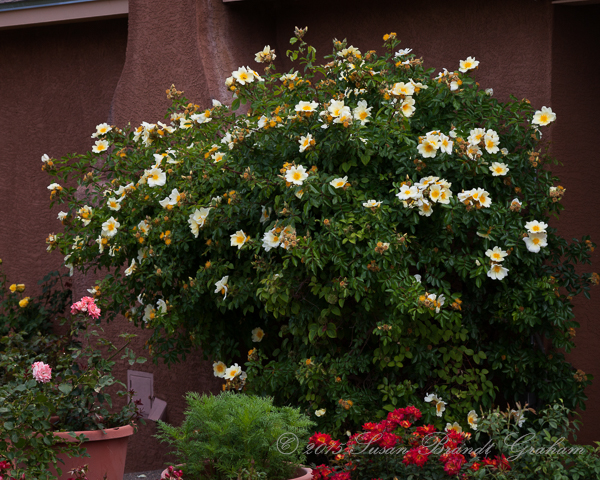
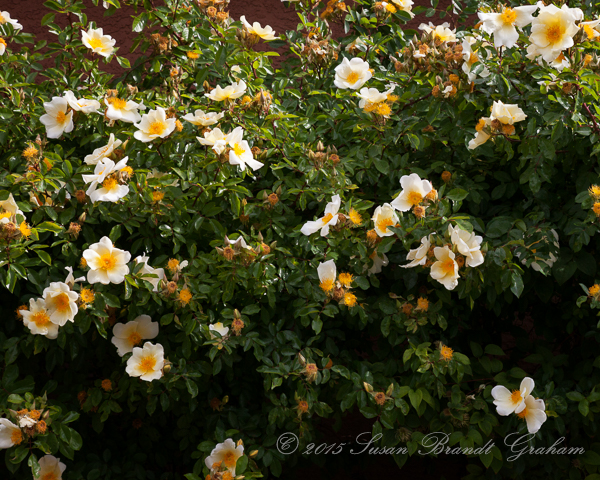
These are images from this year’s spring bloom:
Old Garden Rose, MermaidOld Garden Rose, MermaidOld Garden Rose, Mermaid
Mermaid – one of my favorite roses, and back to being a focal point in the garden of my small Albuquerque yard.
Beautiful small yard: Albuquerque is surrounded by Federal lands of one type or another on the north, east, and south. Yards within Albuquerque proper tend to be small, compared to other places I have lived. The weather beckons people out of doors most of the year. Attractive yards in which to spend time are desirable, but sometimes making a very small yard attractive takes some thought and planning.
Water was not always considered a problem in Albuquerque, although it certainly is now. Ideally, the native plants would have been left when homes were built. Instead, the land was bulldozed clear of the native plants in many parts of Albuquerque (as well as other places in the Desert Southwest). New homes are often being xeriscaped from the beginning.
This home was built in the late 1990’s. This yard has been featured in several posts on this blog. It has not only matured, but the owner has tried to decrease the use of water by removing some plants, while keeping the foundation plantings and then a few for color. A lot of work has gone into this yard, but the owner has certainly achieved a beautiful small yard.
Beautiful small yard
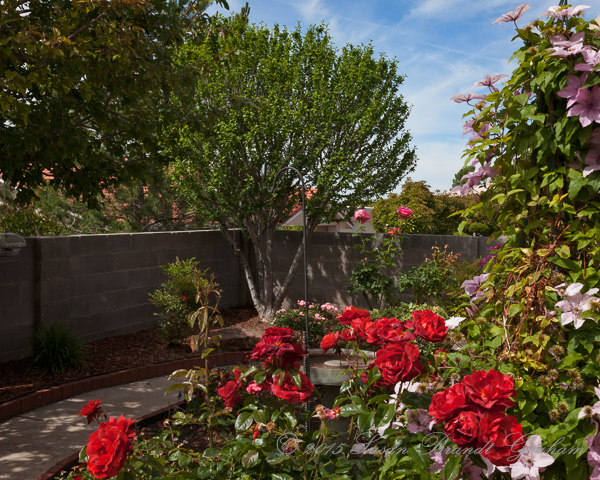
The beautiful New Mexico sky is a constant feature here. Plants featured here,and these have been longstanding, are roses ‘Hot Cocoa,’ ‘Gentle Giant,’ and ‘Baby Grand;’ clematis trained on a pillar; two nandina bushes; and the Rose of Sharon, ‘Blushing Bride,’ trained into more of a tree shape than a shrub. This will bloom later in the summer. Although the yard is small, the plants give a lot of privacy here.
Morning in the roses, especially when they are at the peak of spring bloom, is such a refreshing start to the day. I thought I would share a bit of my morning walk with you.
A Variety of Roses
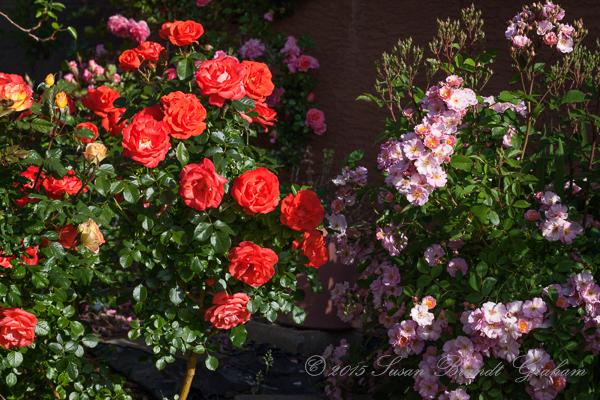
Blooms in this image are the floribundas ‘Chihuly,’ ‘Marmalade Skies,’ ‘Dream Weaver,’ and the shrub, ‘Flower Girl.’
This next image shows the hybrid tea, ‘Veterans’ Honor,’ one of my favorite reds.
‘Veterans’ Honor’
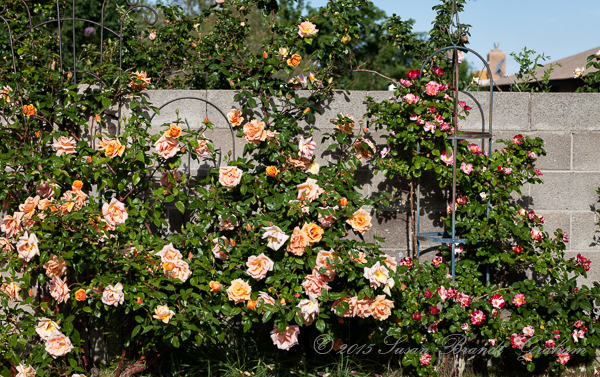
My neighbors and I share a wall of climbers. In this image, on my side, you see ‘Royal Sunset’ and ‘Fourth of July.’ They have ‘Eden,’ ‘Climbing Peace,’ ‘Don Juan,’ and ‘Royal Sunset.’ It is very nice to have neighbors with such a wall of blooms!
On my side, ‘Royal Sunset’ and ‘Fourth of July’
Our winter here in the high desert was so warm this year, that spring bloom has reached it peak quite early. I have enjoyed it immensely, of course.
The Albuquerque rose show is the last weekend of May this year. The early bloom may affect the number of blooms entered, although perhaps people in cooler areas (here in Albuquerque, as well as in Santa Fe) may have more blooms than usual to enter.
The floribunda ‘Marmalade Skies’ is a real eye-catcher in the garden. Its bright orange color screams for recognition, even from a distance.
This rose is capable of making large sprays, but at the moments, it is producing solitary blooms. The blooms of this floribunda can have close to exhibition, for a brief period of time. This is when the color is most intense.
‘Marmalade Skies’ with close to exhibition form
The blooms can open fully within a day. This image was taken during Golden Hour, and the orange of the fully open bloom seem almost fluorescent. Fully Open ‘Marmalade Skies’
Rose people generally focus a lot on the stamens of a fully open rose to assess its freshness (in a rose show). The stamens of this very fresh fully open ‘Marmalade Skies are not spectacular. But I was struck by the beauty of the stigmas and red styles of this rose. I have had this rose for some time, but had never really paid much attention to this. I am glad I noticed it this year! Stamens, stigmas, and styles of fully open ‘Marmalade Skies’
This rose lives happily in the high desert and Albuquerque area, and, once established, requires very little water. It can be a show stopper in the garden, and is a useful rose for arrangements.
First Bloom of Roses: Such an Exciting Time in the Spring!
First bloom of roses is something every gardener who grows roses anticipates. The first flush of blooms is usually, although not always, the most spectacular of the year. The roses in my yard have not yet reached the peak of first bloom, but I am so delighted to see blooms burst forth, I am going to share some of the early ones here.
‘Incognito,’ a wonderful miniature rose‘Misty Moonlight,’ my sport of ‘Dream Weaver’Shrub rose, ‘Be-Bop’Another view of the shrub rose, ‘Be-Bop’
Over the next couple of weeks, many more roses should be blooming, more in terms of both variety and quantity. Expect more pictures to be posted here.
Rose buds. Over the winter I showed you some rose hips and some spent blooms, but now first bloom is very close! Most of the rose buds in my yard are now showing some color, a promise of a riot of color in a few days. Last week, with the one night of freezing temperatures at my house and close to freezing the night before slowed the process just a bit. But, the nights are warmer now, and many of these should be open this week. These images are just a sampling of my roses getting ready to bloom in a very small Albuquerque yard.
Miniature rose, ‘Yoyo.’ Miniature rose, ‘Yoyo,’ covered with buds
Bud of miniature rose, ‘Yoyo,’ about to open. Close up of bud of ‘Yoyo’
Bud on small spray of shrub rose ‘Flower Girl,’ about to open. ‘Flower Girl’ can make huge sprays, and some seem to be developing for a little later. Bud of shrub rose, ‘Flower Girl’
Tis large flowered climber, ‘Royal Sunset,’ makes long and elegant buds. The elegant bud of the large flowered climber, ‘Royal Sunset’
I hope later in the week to show a lot of colorful blooms!
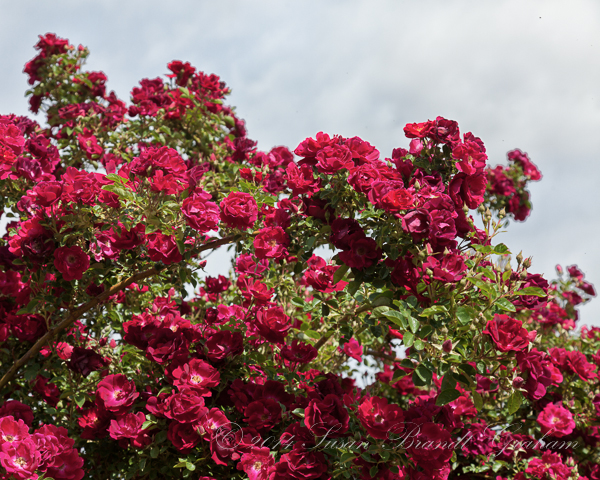
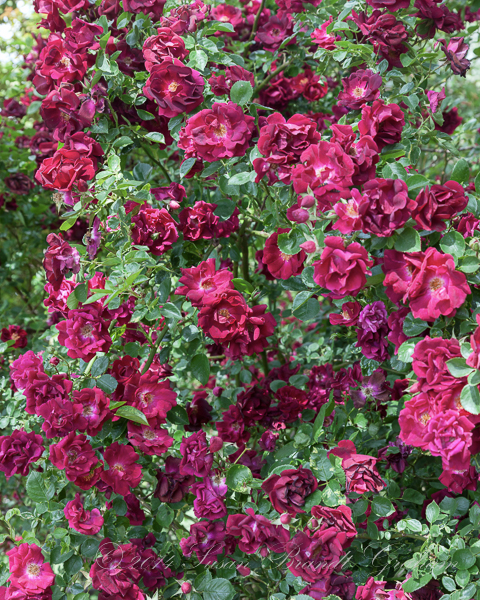
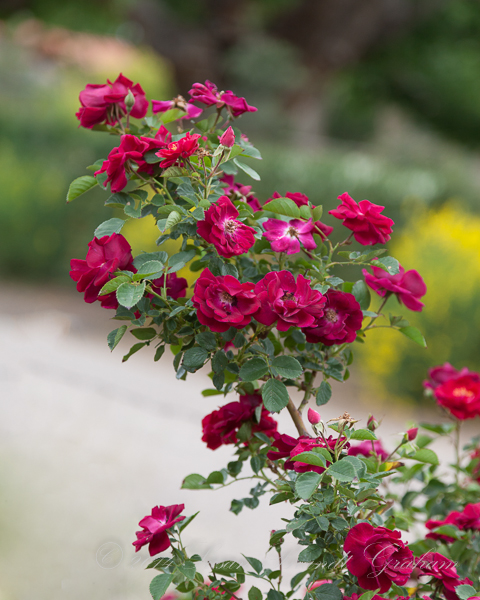
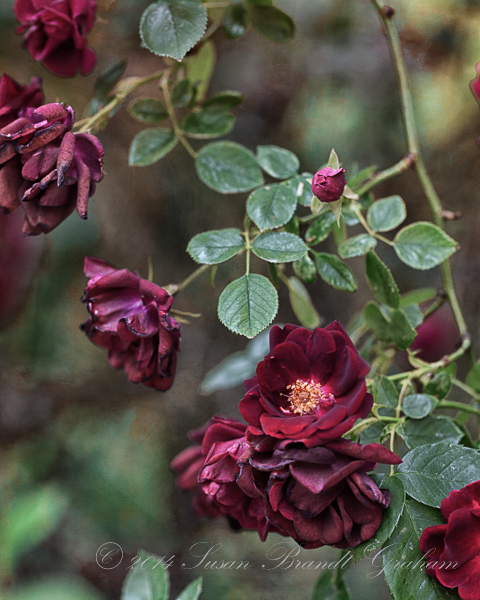
Dr Huey, a hybrid wichurana, is a rose known in some form to most rose growers. A very few people grow it as the rose itself, but that is the exception rather than the rule. It is a mildew magnet, at least in my yard, and a once bloomer. During the spring bloom, however, it can be spectacular.
For many years Dr Huey has been used a root-stock onto which to graft roses known for their blooms. It has been very useful for that purpose.
Many of us encounter Dr Huey when we have “shovel pruned” a rose and not completely gotten out the roots of this root-stock. We may also encounter it after various adverse conditions – drought, cold, and so forth – have stressed the grafted rose, and only the strong root-stock remains. That is one way of saying I have it in my yard every now and then. If it appears in the spring, I usually leave it until after the local rose show in case I want to use the foliage as line material in arrangements. Then, I will work to remove it so the planned rose in that spot can grow without competition from the strong root-stock.
Here in the high desert in the Rio Grande Valley, we have a variety of growing conditions that challenge the most dedicated gardeners. Once the soil has been amended, roses do pretty well where I live in Albuquerque if they get adequate water. In February 2011 we had an extreme cold snap from which I did lose some roses, but that is rare. We do not winterize our roses here, because it generally is not necessary. I live up toward the mountains and away from the river.
I have good friends who live right along the Rio Grande. We all learned in school that “warm air rises and cold air sinks.” When I go to visit them, even on the hottest summer days, I always take a jacket along if I am going to be there after sunset. It gets cold. In the winter, although the daytime temperatures may be similar to mine, the night temperatures can be up to 20°F colder. Their last average frost-free date can be a month later than mine. “We’re hard on roses here.”
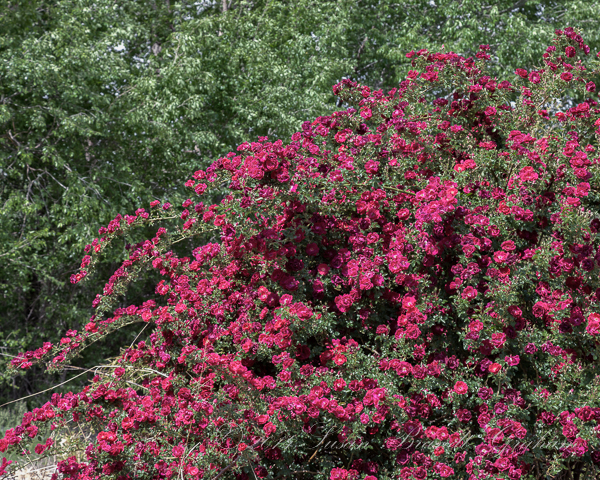
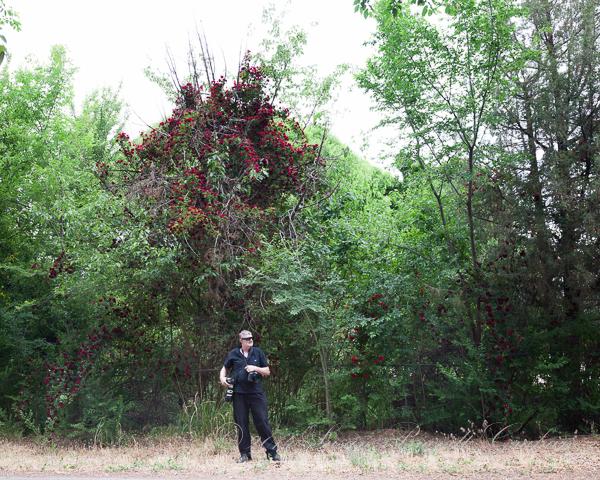
My friends are not the only ones who are “hard on roses” in the Rio Grande Valley. The entire community in which they live is “hard on roses,” if, that is, they are grafted roses. For a week or two in the spring, Dr Huey can be seen in bloom everywhere, and it is quite beautiful. This rose can get huge, and covered with blooms can be very spectacular.
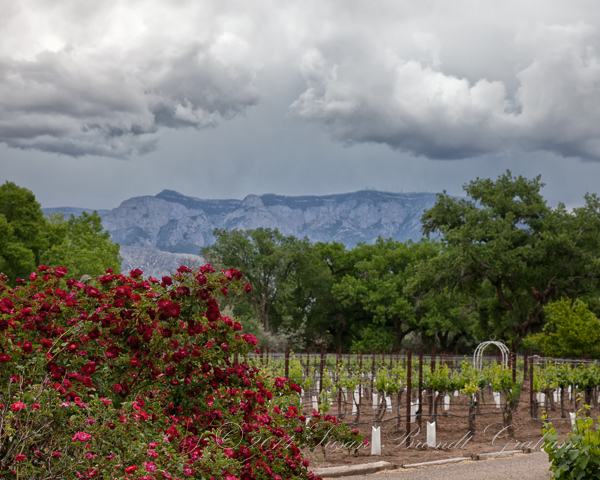
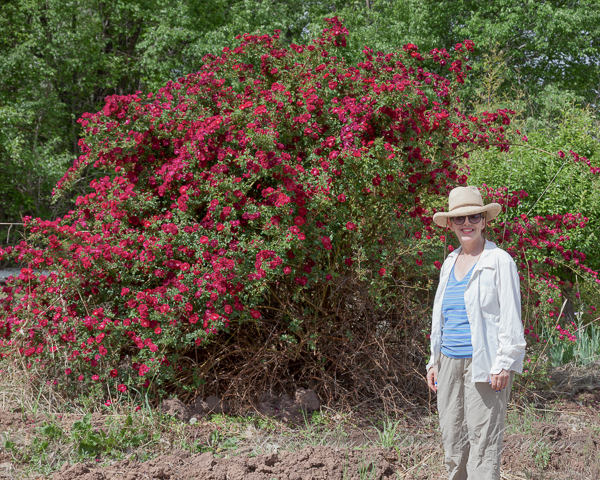
These images of Dr Huey are from the First Annual Dr Huey Rose Tour of the Corrales Rose Society, last year (2014).
Dr Huey at entrance to vineyard in the Rio Grande Valley. It was a stormy day.Laurie with Dr Huey at her homeDr Huey at Tim and Laurie’s homeDr HueyDr HueyDr Huey on the roadClose up of very large Dr HueyHUGE Dr Huey. Follow it out to the sides of the image!